





Introduction: Dive into the Heart of Siena Cathedral
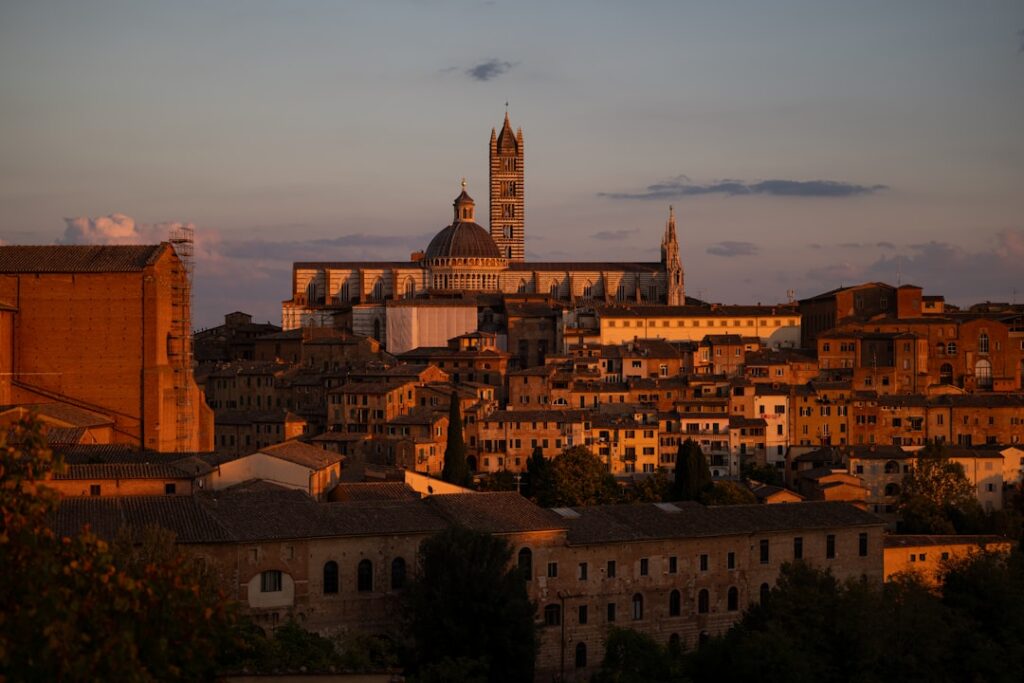
Siena, a medieval city perched on three Tuscan hills, guards one of Italy’s most captivating artistic and spiritual treasures: the Duomo di Siena, officially the Cattedrale Metropolitana di Santa Maria Assunta. At the crossroads of faith, civic power and art, the Duomo is more than a cathedral: it’s a living museum, a sculpted and painted manifesto, an illuminated library and a marbled floor that tells centuries of stories. The wealth of materials—white, green and red marble, mosaics, inlaid marbles, frescoes and sculptures—makes it an essential stop for curious travelers and art lovers alike.
Approaching the Duomo means moving through a series of atmospheres: the wind-swept, lively Piazza del Campo, then the more intimate, sacred Piazza del Duomo. The polychrome porch and façade grab your attention with their profusion of ornamentation and carved stories—patron saints, biblical episodes and civic symbols. Inside, the nave and choir unfold around an extraordinary marble pavement, famous for its narrative and allegorical inlays. But the experience goes beyond mere viewing: visiting the Duomo is a multi-site itinerary—the cathedral itself, the Biblioteca Piccolomini, the Museo dell’Opera del Duomo, the Battistero di San Giovanni and sometimes temporary exhibitions—each offering a different level of surprise and intimacy.
This article walks you through the secrets of Siena’s Duomo: how to plan your visit, where the major works are located, exact addresses and opening times, ticket prices, and local tips that will help you fully appreciate this masterpiece. We’ll highlight visual favorites—from Nicola Pisano’s pulpit to Pinturicchio’s frescoes and the outstanding Museo dell’Opera collection—and give practical advice to avoid crowds, make the most of your time and decode the spiritual and civic language embedded in every stone.
 Click here to book your ticket for the cathedral and the library
History and Architecture: Reading the Façade, the Plan and the Stones
The Duomo di Siena – Cattedrale Metropolitana di Santa Maria Assunta (Piazza del Duomo, 8, 53100 Siena SI, Italy) is an architectural palimpsest. Its Romanesque-Gothic structure, begun in the 12th century, went through multiple building campaigns and reinterpretations over the centuries. The façade, designed by Giovanni Pisano in the early 14th century, is a true marble book: biblical scenes, prophets, symbolic animals and allegorical figures intertwine. Look at the central rose window and the statues on the piers—every detail aims to educate the faithful and assert Siena’s identity as a mercantile and spiritual city.
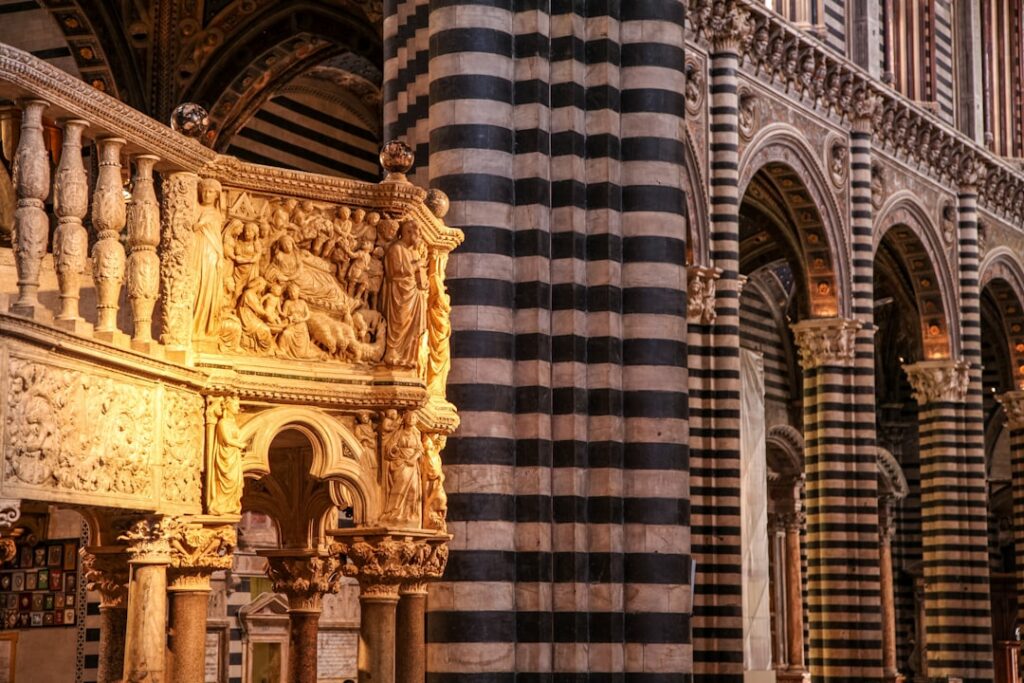
Inside, the structure is marked by chromatic alternations—bands of light and dark marble—that create an instantly recognizable visual rhythm. But the real treasure is the pavement: a series of inlaid marble panels (opera del pavimento) covering the nave and choir, created between the 14th and 19th centuries. These panels tell mythological, allegorical and religious stories, the work of several masters. Many scenes are only partially visible because they are protected by covers in winter; the best time to see the pavement fully revealed is usually June to October (check exact dates before your visit).
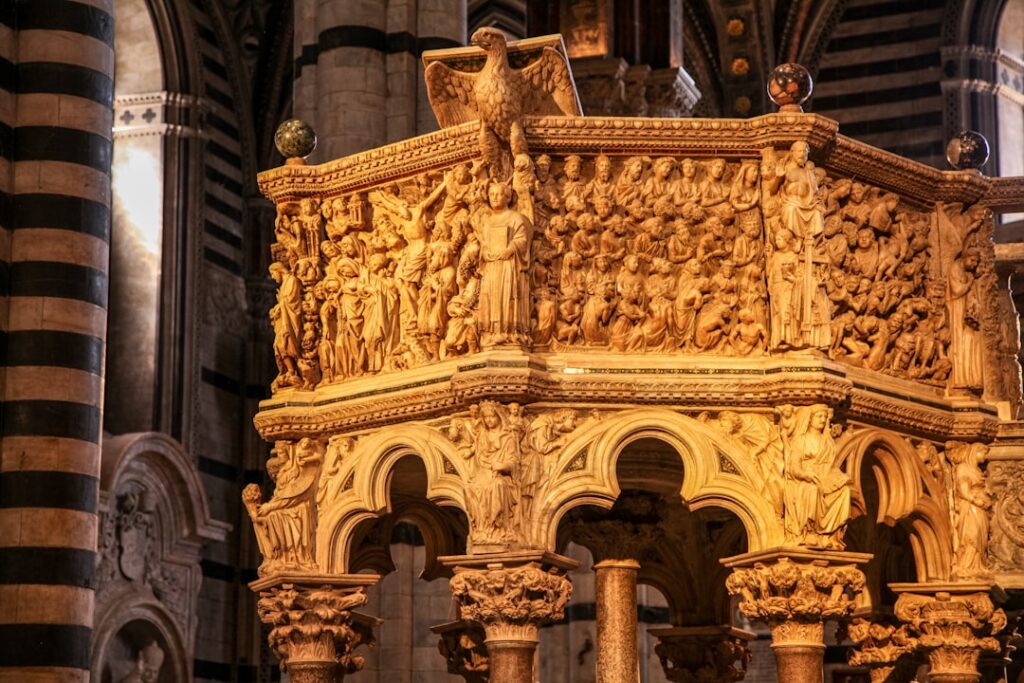
Don’t miss Nicola Pisano’s marble pulpit, a masterwork carved between 1265 and 1268, which marks a classical revival in the Middle Ages. The details of the figures and the use of perspective are remarkably refined. Above the apse, the frescoes and stained glass add narrative and spiritual depth; the choir, decorated with carved panels and gilded ornaments, reveals the central role of liturgy and devotion in Siena’s communal life.
Click here to book a walking tour and skip-the-line ticket for the Duomo
Must-See Spaces: Biblioteca Piccolomini, the Baptistery and the Museo dell’Opera
The Duomo is not a single standalone building but a complex: to grasp its full richness you need to visit several complementary spaces. The Biblioteca Piccolomini, located within the cathedral complex, is one of the hidden gems. This Renaissance library, founded by Cardinal Francesco Piccolomini (later Pope Pius III), has walls covered in frescoes by Pinturicchio (1494–1496) that narrate the life of Pope Pius II and allegorical scenes. Exact address: Biblioteca Piccolomini, Piazza del Duomo, 8, 53100 Siena SI, Italy. Indicative opening hours: 10:00 – 17:00 (closing times vary by season). Admission: around €6 (check current rates).
The Battistero di San Giovanni (Battistero of the Duomo) sits just behind the cathedral’s choir and is accessible from the same complex (same address). Here you’ll find a richly decorated baptistery, ornate baptismal fonts and remarkable frescoes. The space displays a collection of liturgical objects and sculptures. Entry is usually included in the combined complex ticket or available with a separate ticket. Hours: often 10:00 – 17:30; price: included in the combined ticket or about €3–5 if bought separately.
Finally, the Museo dell’Opera del Duomo (Piazza del Duomo, 8, 53100 Siena SI) houses original works removed from the cathedral for protection: façade sculptures, panels, paintings and liturgical objects. The museum also explains the history of the Duomo’s construction and restoration. Hours: 10:00 – 18:00 (seasonal variations); price: often included in the combined ticket (see below)—if separate, count around €8–10. Visiting this museum deepens your understanding of the techniques, materials and conservation challenges.
Click here to buy the cathedral pass with audio guide
Tickets, Opening Hours and a Sample Itinerary: Make the Most of Your Visit
To fully enjoy the Duomo and its complex, it’s recommended to buy a combined ticket (often called the “Complesso del Duomo” or “Opera del Duomo di Siena pass”) which includes entry to the Duomo, the Museo dell’Opera, the Biblioteca Piccolomini, the Battistero and sometimes other adjacent spaces. Indicative prices: Combined adult ticket: €16, reduced rate: €13. Single entry to the cathedral (for tourist visits outside services): around €5. These rates are indicative and can vary with season, temporary exhibitions and discounts (students, seniors, school groups). It’s strongly advised to check the official Opera del Duomo di Siena website before your visit.
Opening hours: typical hours fall between 10:00 and 18:00 (10:30–17:30 off-season), but note the cathedral may close temporarily for religious ceremonies, Masses or private events. The Biblioteca Piccolomini and the Museo dell’Opera often have slightly tighter schedules. Tip: arrive early, right at opening, to avoid the crowds and enjoy ideal light for photos in the nave and on the pavement. If you visit in high season (May–September), reserve a time slot online.
Suggested itinerary (total time 2 to 3 hours):
- Step 1: Façade and exterior—linger over the reliefs and sculptures.
- Step 2: Inside the Duomo—see Nicola Pisano’s pulpit and the pavement (allow at least 45 minutes).
- Step 3: Biblioteca Piccolomini—admire Pinturicchio’s frescoes (30–40 minutes).
- Step 4: Baptistery—view the fonts and frescoes (20–30 minutes).
- Step 5: Museo dell’Opera—finish with the originals and the monument’s story (30–60 minutes).
Click here to book an exclusive morning Duomo visit
Local Practical Tips: When to Go, How to Get There, Where to Eat and Sleep
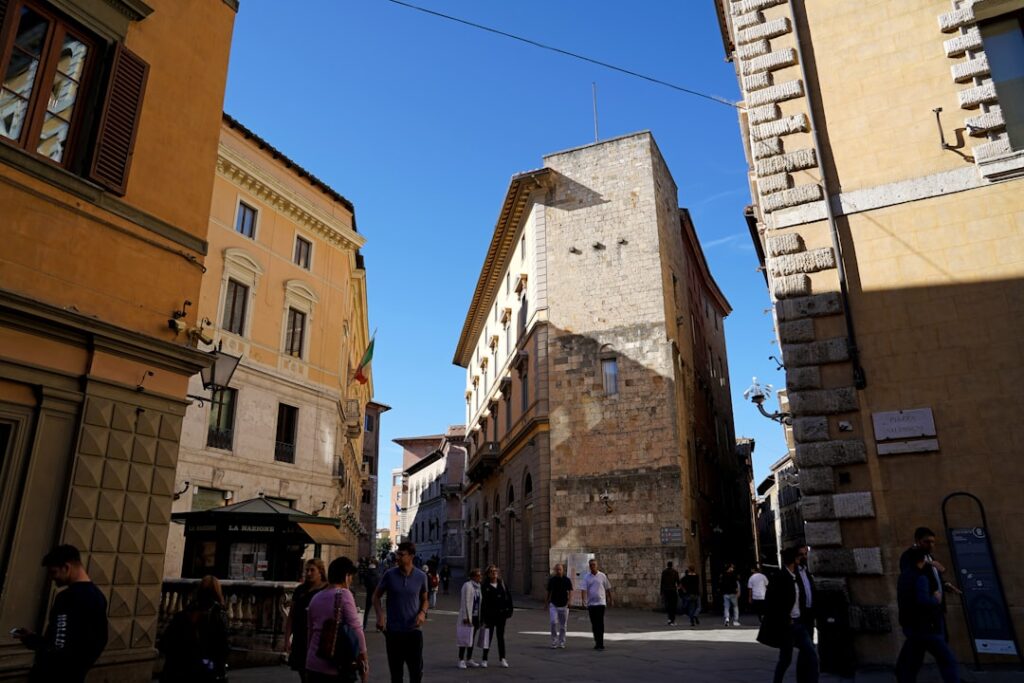
Getting around Siena: the Piazza del Duomo is just steps from the famous Piazza del Campo (Piazza del Campo, 53100 Siena SI). To reach the Duomo from Siena train station (Via della Sapienza, 53100 Siena SI), expect a 15–20 minute uphill walk; taxis and buses are available, but the historic center is best explored on foot. Full complex address: Piazza del Duomo, 8, 53100 Siena SI, Italy.
Weather and clothing: Tuscany can be very hot in summer and chilly in winter. Wear comfortable shoes—the medieval streets are paved and steep. Respect the dress code for religious sites: covered shoulders and knees may be required to enter the cathedral or attend Mass.
Food and breaks: around the Duomo and in the neighborhood (Via San Marco, Via dei Pellegrini) you’ll find traditional trattorie and cafes. A few practical picks:
- Osteria Le Sorelline (Via di Città)—local cuisine, great for a Tuscan lunch before or after your visit.
- Enoteca I Terzi (Via della Sapienza)—good selection of Chianti-region wines and antipasti.
- Gelateria Fiordilatte (near Piazza del Campo)—perfect for an ice-cream break.
Indicative prices: an espresso €1–2, a simple trattoria lunch €12–20 per person, a more formal dinner €25–50.
Accommodation: staying in the historic center (Via di Città, Via Banchi di Sopra) puts you less than a 10-minute walk from the Duomo. Options:
- Charming historic hotels (palazzo-style, 3–4*) : around €80–150 per night off-season.
- Airbnb and apartments: €60 to €200 depending on size and season.
Book well in advance, especially during the Palio (July 2 and August 16), when the city is extremely busy.
Click here to enjoy a grand wine tasting in an Etruscan crypt
Click here to take a day trip to Siena from Florence
How to Read the Works: Symbols, Stories and Anecdotes to Know
The Duomo is a dictionary of symbols. To fully engage with the works, a few keys will ease your discovery. The façade is organized like a three-dimensional narrative: scenes from the New Testament, saints’ figures, allegories of virtues and vices. Giovanni Pisano’s sculptures stand out for their dynamism and expressiveness: they announce a more human, dramatic vision of the sacred compared with earlier Romanesque art.
The pavement (opera del pavimento) is a visual encyclopedia: each panel is a marble fable. You’ll find episodes from the Old Testament, mythological narratives and allegorical figures representing Justice, Wisdom, Love, and more. Artisans used colored marbles to create pictorial depth; the result is a sort of narrative carpet that the community walked on and contemplated.
Local anecdotes:
- The “great unfinished cathedral”: in the 14th century a monumental expansion (the « Duomo Nuovo ») aimed to make Siena the largest ecclesiastical city in Italy. The Black Death of 1348 and financial troubles halted the work; remnants of the project are visible near the current library and explain the contrast in scale across the complex.
- The originals moved indoors: many façade sculptures were removed and placed in the Museo dell’Opera to protect them from the weather. This move is a boon for visitors: you can see these works in a museum setting, up close and under better lighting than on the exterior façade.
Click here to join a private 3-hour tour with an optional cathedral visit
Photography Tips and Respecting the Space
Taking photos at the Duomo is always tempting, but there are rules to respect to preserve the sacred space and the quality of the visit for everyone. Practical rules:
- Check the photo policy: in some areas (like the Biblioteca Piccolomini) photos may be restricted or forbidden without permission. In the cathedral, non-flash photography is usually allowed but follow signs and staff instructions.
- Best time: early morning (or the hour before closing) for soft light and fewer people. Side light brings out the façade’s reliefs and the interior marble inlays.
- Angles to favor: for the façade, step back to the opposite Piazza del Duomo for a full composition; for the pulpit and the pavement, use a wide-angle lens and avoid flash to capture perspective.
Respect: don’t speak loudly, don’t block aisles, and remove your hat in liturgical spaces. The Duomo remains an active place of worship; some visitors come to pray and meditate.
Click here to discover the Duomo with panoramic city views
Click here to book a guided walking tour with Duomo entry
Conclusion: Why Siena Cathedral Is a Must-See
Siena Cathedral is not just another stop on a sightseeing checklist: it’s a multi-dimensional experience where art, history and civic life meet. Every stone tells a chapter of Sienese history: the faith that mobilized generations of craftsmen, the civic ambitions of an independent republic, and the vicissitudes (plague, wars, restorations) that shaped the city’s soul. Visiting the Duomo means reading that story aloud as you study Nicola Pisano’s pulpit, Pinturicchio’s frescoes, the marbled pavement and the treasures of the Museo dell’Opera.
Practically speaking, prepare your visit: buy a combined ticket to save time, reserve a time slot if you come in high season, favor early morning or late afternoon for light and quiet, and make time for annexed spaces like the Biblioteca Piccolomini and the Battistery. Sample the local cuisine in nearby trattorie and lose yourself in the medieval lanes that lead to the Piazza del Campo. Above all, respect the sacred character of the place and allow yourself to listen: often, silence reveals as much as sight.
Whether you’re an amateur historian, a photographer, a pilgrim or a curious traveler, Siena Cathedral offers a concentrate of emotion and knowledge. By lingering over carved details, taking time to admire the pavement inlays or reading the fresco narratives, you’ll sense the depth of a city that turned faith and skill into universal works. Enjoy your trip to Siena—and may your visit to the Duomo be full of discoveries and awe.