





Introduction
Siena is one of those Italian towns where every stone tells a story, where narrow alleys suddenly open onto monumental squares, and where religious and civic art have shaped local identity for centuries. The Duomo di Siena — Cattedrale di Santa Maria Assunta — is the artistic and spiritual heart of the city, but the reach of its major works extends well beyond the building itself. Within a very short radius you’ll find a museum, an ornate library, a former hospital turned exhibition space, a small baptistry and even the grand Palazzo Pubblico in the historic center — all hosting essential works to understand Siena’s golden age.
This article lays out a detailed, practical route to discover seven must-see works or groups of works a stone’s throw from the Duomo di Siena. Each entry includes the exact address, typical opening hours, indicative prices in euros, an evocative description to help you picture the piece on site, and local practical tips (best times to visit, combo tickets, access, photo spots and ways to avoid crowds). Whether you’re an art history buff, a photographer hunting angles, a traveler short on time or a contemplative visitor, this guide will help you plan an efficient and enjoyable cultural stroll around the Duomo.
The suggested order isn’t strictly chronological: it’s designed to optimize a walking visit around the Piazza del Duomo and the surrounding lanes while emphasizing the sensory experience — the way light plays on the marble, the density of the frescoes, the perspective from the Facciatone terrace, and the tangible presence of artists who shaped the city, like Duccio, Pinturicchio or the Lorenzetti brothers. Expect to alternate between intimate, finely detailed works (marble inlay floors) and the grand narratives of civic fresco cycles. Remember: Siena is best experienced slowly, like a good Tuscan wine — take time to sit on a step, listen to the organ, and let the history speak to you.
One practical tip before you start: most sites offer combined tickets (Duomo + Museo dell’Opera + Facciatone + Biblioteca Piccolomini) which both save money and let you skip lines. Opening hours change with the season and religious celebrations (the Duomo is sometimes closed for services), so check official information the day before. Now, let’s discover the seven works you shouldn’t miss around Siena’s Duomo.
Cattedrale di Santa Maria Assunta (Duomo di Siena) — The façade, the nave and the pavement
Address: Duomo di Siena, Piazza del Duomo, 8, 53100 Siena SI, Italy.
Opening hours (indicative): Monday to Saturday 10:30 – 18:30; Sunday 13:30 – 18:00. Note: hours may change for religious services.
Price (indicative): Combined ticket Duomo / Baptistery / Museo dell’Opera / Facciatone / Biblioteca Piccolomini: €12–€18 depending on discounts and season. A Duomo-only ticket is sometimes included in the combo.
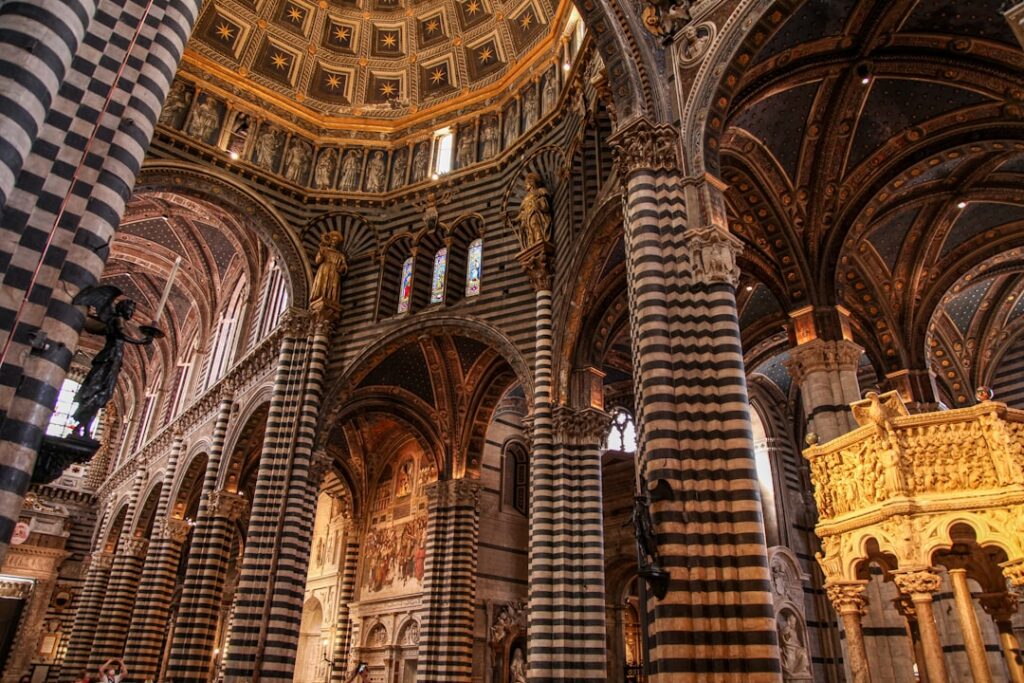
Siena’s cathedral is a lesson in contrast and refinement. Its polychrome façade of white and dark green marble, decorated with niches and bas‑reliefs, sets the tone as you approach. Inside, the Gothic nave stretches out to reveal an exceptional floor: the famous pavimento marmoreo, a series of 56 marble inlay panels that depict biblical episodes, allegories and mythological figures. These compositions — by late medieval and Renaissance artists (such as Domenico di Bartolo, Sano di Pietro and others) — are hard to grasp in a single view when the cathedral is full; it’s better to kneel or sit in the transepts to feel the depth of the scenes.
The side chapels hold paintings, statues and Baroque altars; the high altar and the dome reveal an architecture played out through height and filtered light. If you’re sensitive to texture, notice how the marble veins seem to dance under your fingertips — each slab was chosen to converse with the next. The Duomo is also a living space: services, organ concerts and masses take place throughout the week. For photographers, the best light to capture the nave is early morning shortly after opening, or late afternoon when side light sculpts the columns.
Practical tips: buy the combined ticket in advance to avoid the line, prioritize an early morning visit to see the pavement, and remember to respect silence and appropriate dress inside this place of worship. Some parts of the pavement are covered in winter for protection: check before planning a visit solely to see the slabs.
 Click here to book your ticket for Siena Cathedral and the Piccolomini Library

The side chapels contain paintings, statues and Baroque altars; the high altar and the dome demonstrate an architecture shaped by height and light. If textures appeal to you, pay attention to the movement of marble veins beneath your hand — every slab was chosen to interact with its neighbor. The Duomo remains a living place: services, organ concerts and masses fill the week. For photographers, early morning or late afternoon provide the most flattering light inside the nave.
Practical tips: book the combined ticket ahead to skip queues, visit early for the pavement, and respect the decorum required in places of worship. Parts of the pavement may be covered in winter to protect them: check availability if the marble floor is your main reason for visiting.
Biblioteca Piccolomini — Pinturicchio’s frescoes and the cardinal’s study
Address: Biblioteca Piccolomini, Piazza del Duomo, 8, 53100 Siena SI, Italy (entrance via the Duomo complex).
Opening hours (indicative): generally 10:30 – 18:00, often included in the Duomo/Museum combo.
Price (indicative): included in the combined ticket (€12–€18), visits may be limited to small groups.
The Piccolomini Library is an intimate gem tucked inside the Duomo complex. Commissioned in the 15th century by Cardinal Francesco Piccolomini (the future Pope Pius III), it is entirely decorated with frescoes by Bernardino Pinturicchio and his workshop. These frescoes, remarkable for their storytelling and delicate drawing, depict episodes from the life of the Virgin alongside themes linked to the Piccolomini family, blending religious significance with papal splendor.
What strikes you inside is the richness of the backgrounds: lush landscapes, idealized palaces, and architectural details that reflect the era’s obsession with presenting the world as a stage. The colors, still vibrant, give an almost private intimacy — as if you’ve been invited into a Renaissance prince’s private chamber. Illuminated manuscripts and period furniture complete the experience: the library was not simply decorative, it was a place of study and intellectual prestige.
Click here to book a walking tour and skip-the-line ticket for the Duomo

The library was not merely decorative: it functioned as a place of study and a symbol of intellectual prestige.
Practical tips: the visit can be short but intense — allow 20 to 30 minutes to take in the details. Access can be limited to small groups to preserve the frescoes, so book if possible. Guided visits often reveal heraldic symbols and papal references that might escape an untrained eye.
Museo dell’Opera Metropolitana — Duccio, sculptures and the grand story of the Maestà
Address: Museo dell’Opera Metropolitana (Museo dell’Opera del Duomo), Piazza del Duomo, 9, 53100 Siena SI, Italy.
Opening hours (indicative): 10:00 – 18:30 (hours may vary).
Price (indicative): included in the combined ticket €12–€18; single entry ≈ €8–€12.
The Museo dell’Opera Metropolitana is where the Duomo’s material history is concentrated. Here you’ll find masterpieces removed from the church for preservation. The most famous are undoubtedly the panels and fragments of Duccio di Buoninsegna’s Maestà, the great polyptych painted for the cathedral’s high altar in the early 14th century. Reassembled in the museum, the Maestà reveals the scale of its narrative and the delicacy of its panels: scenes from the life of Christ and the Virgin, portraits of saints and hagiographic cycles.
The museography highlights restorations, allowing you to appreciate brushes, paint layers and gilding that have survived the centuries. Other sculptures and architectural fragments on display recount the story of the façade, liturgical furniture and works moved for conservation reasons. The museum’s scientific approach, with explanatory panels and considered lighting, turns the visit into a lesson in conservation and art history.
Practical tips: allow at least 45 minutes to an hour to calmly explore the museum. If you like iconographic detail, consult the small museum guide (available in several languages). Staff are usually happy to explain the route and the major works. Visiting in the morning gives you more privacy to photograph the panels (no flash).
Click here to buy the pass for the Duomo complex
Battistero di San Giovanni — The baptistry and the baptismal font
Address: Battistero di San Giovanni, Piazza del Duomo, 53100 Siena SI, Italy (within the Duomo precinct).
Opening hours (indicative): often 10:00 – 17:30, included in the Duomo combined ticket.
Price (indicative): included in the combined ticket €12–€18.
The Battistero di San Giovanni sits adjacent to the Duomo and deserves a visit for its important baptismal font and surrounding sculptures. The baptistry houses reliefs and decorations illustrating the ritual of baptism and biblical cycles; the subdued lighting and intimate proportions give a very different feel from the Duomo’s nave. Your eye is immediately drawn to the basin and the carved panels that adorn it, as well as the paintings on the walls that narrate religious episodes in an almost domestic atmosphere.
Its proximity to the cathedral makes the baptistry a logical stop: it helps you better understand medieval liturgy and the role of baptism in the Sienese community. The sculpted details on the baptismal font, often hard to appreciate from a distance, reveal the hands of skilled visual storytellers.
Practical tips: when you visit, approach the basin slowly and look for engraved inscriptions; they sometimes record donors or dates of creation. The baptistry can be quick to see, but don’t skip it — a few minutes of focused attention are enough to appreciate the quality of the reliefs.
Click here to buy the pass for the Duomo complex
Santa Maria della Scala — The former hospital turned museum and its pictorial cycles
Address: Santa Maria della Scala, Piazza del Duomo, 2, 53100 Siena SI, Italy.
Opening hours (indicative): 10:00 – 19:00 (hours vary with exhibitions).
Price (indicative): single entries €8–€14; reductions for youth/students.
Facing the Duomo, Santa Maria della Scala is a sprawling complex that was one of Europe’s oldest hospitals and today houses a major museum. The rooms, corridors and chapels preserve large narrative cycles and frescoes tied to charity, sanctity and the everyday life of former patients and pilgrims. Temporary and permanent exhibitions alternate medieval art, archaeological finds and modern displays — all within an emotionally charged setting where the architecture itself speaks of care and mercy.
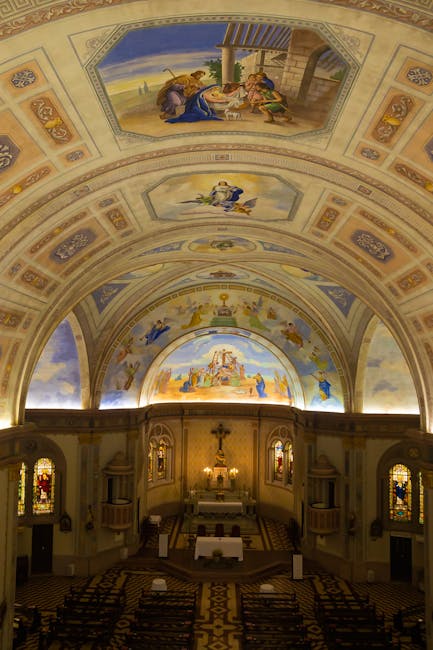
Highlights include narrative fresco cycles, votive paintings and themed rooms that explain the hospital’s historic role. The visit focuses as much on images as on social history: who provided care, how donations were organized, and what place Santa Maria della Scala occupied in the pilgrimage routes to Rome and Jerusalem.
Click here to join a guided walking tour of Siena Cathedral
Highlights include narrative fresco cycles, votive paintings and themed rooms that explain the hospital’s historic role. The visit focuses as much on images as on social history: who provided care, how donations were organized, and what place Santa Maria della Scala occupied in the pilgrimage routes to Rome and Jerusalem.
Practical tips: allow enough time (at least one hour) because the site is large and often less crowded than other attractions, which makes it easier to savor the spaces. Audioguides and interpretive panels help explain how images functioned as instruments of care and devotion.
Palazzo Pubblico and Museo Civico — Lorenzetti’s civic frescoes and the Piazzetta
Address: Palazzo Pubblico, Piazza del Campo, 1, 53100 Siena SI, Italy (about a 7–10 minute walk from the Duomo, depending on pace).
Opening hours (indicative): 10:00 – 19:00 (variable).
Price (indicative): Museo Civico entry ≈ €8–€12; combo tickets available.
Though located on the famous Piazza del Campo, the Palazzo Pubblico is a short stroll from the Duomo and a must for anyone wanting to understand the civic dimension of Sienese art. Inside the Museo Civico, Ambrogio Lorenzetti’s fresco series — especially The Allegory of Good and Bad Government — represents the pinnacle of medieval civic art: a political vision translated into images, where virtues, the consequences of justice and economic effects unfold on the walls like a visual manual for rulers.
Click here to book a city tour with Duomo entry and panoramic city views
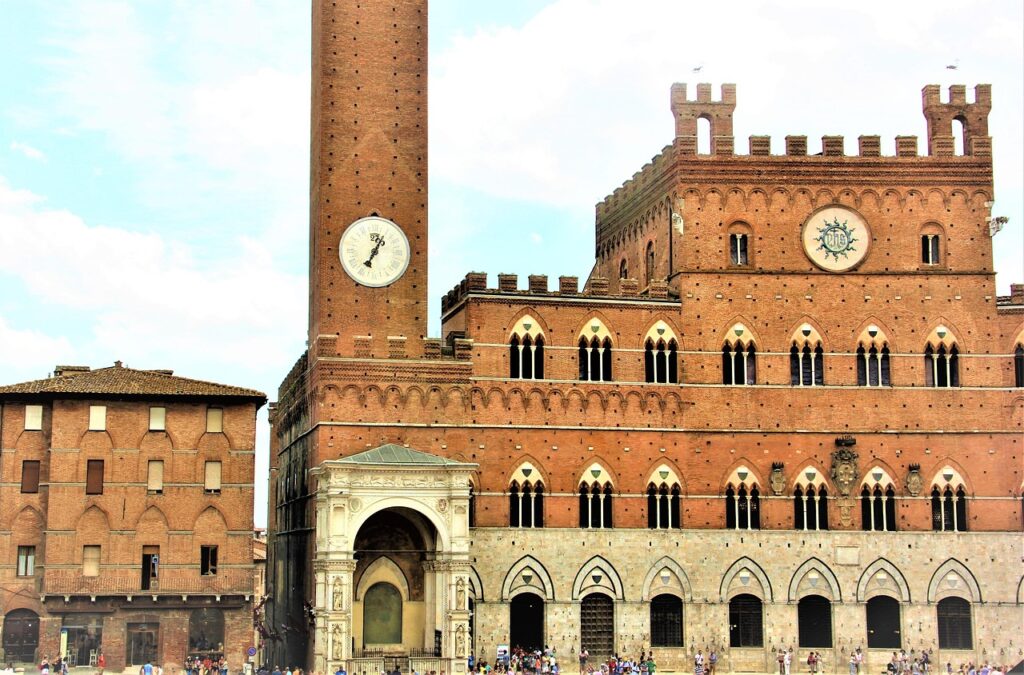
These frescoes are not merely beautiful: they’re didactic, designed to instruct and remind magistrates of the principles of good governance. Stepping onto the Palazzo’s terrace (the Torre del Mangia and the Sala del Mappamondo also offer views) you’ll grasp the relationship between civic space and art: the Piazza del Campo is both stage and agora, and the palace images were visible governance tools for all to see.
Practical tips: combine the museum visit with the Torre del Mangia for panoramic views of Siena (separate tickets may be required). Plan 1 to 2 hours to enjoy the rooms and the fresco narratives, and avoid the middle of the day in high season — the Piazza gets very crowded then.
The Facciatone and the panoramic terrace — A rare angle on the cathedral and the city
Address: Facciatone (Museo dell’Opera del Duomo area), Piazza del Duomo, 9, 53100 Siena SI, Italy.
Opening hours (indicative): often 10:00 – 18:30, included with the Museo dell’Opera ticket or sold separately.
Price (indicative): included in some combined tickets €12–€18; single entry ≈ €4–€6.
The Facciatone is the unfinished façade of the 15th‑century « new cathedral »: today its partial structure serves as a belvedere. Climbing to the Facciatone terrace offers a rare viewpoint: you look down over the Duomo’s dome, embrace Siena’s neighborhoods and grasp the ambitious scale of the project that once aimed to build a larger cathedral. For photography lovers, it’s an ideal spot at sunset, when Tuscan stone warms to golden hues and the Duomo’s silhouette stands out on the skyline.
The visit blends emotion and contemplation: you sense the grandeur left incomplete, the tension between project and reality, and the open space provides a breath between two more concentrated visits. Interpretive panels tell the story of the aborted expansion and the economic and political reasons that halted it.
Practical tips: favor late afternoon for the light, bring a small zoom if you want to capture details of the Duomo’s façade from the terrace, and be aware that the space can be narrow — if you’re prone to vertigo, take care.
Click here to book a tour with Duomo entry and panoramic views
Conclusion
Around Siena’s Duomo unfolds a compact artistic microcosm that sums up the cultural richness of medieval and Renaissance Tuscany: the cathedral’s architectural majesty, Pinturicchio’s narrative delicacy, Duccio’s powerful Maestà, Santa Maria della Scala’s social and charitable testimony, the civic function of Lorenzetti’s frescoes in the Palazzo Pubblico, the intimacy of the baptistry and the liberating view from the Facciatone. Each stop offers a different perspective on the city — liturgical, private, museum-oriented, social and panoramic — and together they form a complete, sensory and scholarly route.
Final tips: buy a combined ticket to optimize your time and save money, visit early morning or late afternoon to avoid the crowds and enjoy flattering light, and show respect in places of worship (modest dress, silence). If you have a full day, leave time to wander the nearby lanes, try a ricciarelli (Siena’s traditional cookie) in a small bakery and sit on a church step to watch everyday life. Remember that Sienese art is not just objects to look at, but experiences to live: take time to listen, observe the details and let the city speak through its works.
Safe travels and happy discoveries — may your stroll around Siena’s Duomo be full of wonder, little finds and quiet moments of admiration.